
Palatal Expander in Kent and Sammamish, WA
A palatal expander gently widens a narrow upper jaw to correct a crossbite, make room for crowded teeth, and support a healthier airway. Dr. Freelove plans expansion from digital records and clinically indicated imaging and, for teens and adults, places the MARPE miniscrews in-office, with no separate surgeon referral for the screws.
Reviewed and approved by Dr. Cameron Freelove, DDS, MS · Last updated

What Is a Palatal Expander?
A palatal expander is an appliance that gradually widens the upper jaw. Because the upper jaw forms as two halves that fuse together over time, an expander can separate and widen them while a patient is still growing, creating room across the arch and correcting a narrow bite.
The American Association of Orthodontists recommends a first orthodontic check no later than age 7 specifically because expansion problems are easier to correct before the midpalatal suture calcifies.
When an Expander Is Recommended
Expansion is never prescribed on appearance alone. Dr. Freelove diagnoses the underlying skeletal or eruption issue first, then recommends expansion only when the upper jaw width is the true cause. The most common indications:
Posterior Crossbite
When the upper jaw is too narrow, the upper back teeth bite inside the lower teeth, a crossbite. Widening the jaw brings the arches back into a normal relationship and is most stable when done while the jaw is still growing.
Severe Crowding
A narrow jaw often does not have room for all the permanent teeth. Widening the arch can create space, which in some cases avoids the need to remove permanent teeth to relieve crowding.
Impacted Teeth
When there is not enough room for a tooth to erupt, it can become impacted, most often an upper canine. Creating space with expansion, sometimes early, can give an impacted or blocked-out tooth room to come in on its own.
Airway & Breathing
The floor of the nose sits directly above the upper jaw, so widening the jaw also widens the nasal airway. Airway health is multi-factorial, and an interdisciplinary approach is recommended.
Expander Types at Freelove Orthodontics & Smile Design
The right appliance depends on age, suture maturity (confirmed by 3D imaging), and the underlying diagnosis. Every expander is planned from the patient’s individual scan and custom-fabricated, not a stock part pulled from a drawer.
| Type | How It Works | Best For | Placed By |
|---|---|---|---|
| Rapid Palatal Expander (RPE) Practice Standard | Custom Hyrax or Haas-style expander. Parents or patient turn the expansion as directed by Dr. Freelove. The appliance then stays passive for 4–6 months while new bone fills the opened suture. | Younger children with less resistance to sutural opening. Typically children 10 and younger. | Dr. Freelove |
| MARPE | Miniscrew-assisted rapid palatal expansion. Small temporary anchorage devices (TADs) anchor into the palatal bone and transfer force directly to the suture, bypassing the teeth. This allows predictable skeletal expansion in teens and adults whose suture has begun to interdigitate and resist expansion. | Younger children with large skeletal deficiencies, teenagers, and adults with greater resistance to sutural opening | Dr. Freelove, placed in-office, no outside referral |
| SARPE | Surgically-assisted rapid palatal expansion. An oral surgeon performs cuts on the upper jaw to reduce resistance, then the expander widens the weakened area. Pre-surgical and post-surgical orthodontics are managed in-office. | SARPE is no longer recommended in most cases due to predictability of MARPE | Oral surgeon + Dr. Freelove coordination |
How Freelove Orthodontics & Smile Design Builds the Appliance
Freelove Orthodontics sends the patient’s intraoral scan and lab prescription to a trusted dental lab, so each appliance is fabricated at the dental lab from a current, precise model of the patient rather than a mailed impression. This shortens turnaround and keeps the fit accurate.
A narrow upper jaw is one of the most common developmental problems in orthodontics, and it is easiest to correct while a patient is still growing. Widening the jaw at the right time can resolve a crossbite, create space so crowded teeth do not need extractions, and open the nasal airway. Dr. Freelove screens for a narrow jaw at every evaluation and uses digital records and clinically indicated imaging to plan the amount and timing of expansion for each patient.
Activation Protocol & Timeline
Expansion is planned from digital records and clinically indicated imaging, which show the width of the jaw and, in teens and adults, the state of the midpalatal suture. A digital scan captures the arch, an in-house 3D-printed model is produced from it, and the appliance is fabricated at the dental lab from that model. Once fitted, the family turns the expander a small amount on a set schedule for 1-3 months, then the appliance stays in place while the new bone stabilizes.
What to Expect During Expansion
Dr. Freelove walks every family through the day-by-day experience before placement so there are no surprises at home.
Pressure & Discomfort
Some children describe a light pushing sensation across the roof of the mouth for the first 3–5 days of activation, not sharp pain. Over-the-counter acetaminophen handles it when needed. The pressure fades as the suture begins to open.
Gap Between Front Teeth
A small gap opens between the upper central incisors within the first week or two. This is the visible confirmation that the suture is separating correctly. The gap closes naturally during retention or is aligned when braces or aligners are placed.
Speech & Tongue
A temporary lisp is normal for 2–3 days as the tongue learns a new resting posture around the appliance. Reading aloud at home speeds the adjustment. Normal speech returns quickly.
Eating
Soft foods for the first week. Avoid sticky candy, ice, hard nuts, and chewy foods that could dislodge the expander or bend the wires. Once active expansion ends and the screw is locked, normal eating resumes.
Palatal Expansion for Teens and Adults
In teens and adults whose palatal suture has become more resistant to expansion forces, a conventional expander alone often cannot widen the jaw. For these patients Dr. Freelove uses MARPE (miniscrew-assisted rapid palatal expansion), which anchors to small temporary screws to move the jaw halves apart. MARPE is placed in-office at Freelove Orthodontics, with no separate oral-surgeon referral for placement.
MARPE (Miniscrew-Assisted RPE): Dr. Freelove places the palatal TADs in-office. The expander connects to the TADs instead of the teeth, transferring force straight into the suture for true skeletal expansion. Not just tooth tipping.
Many practices refer MARPE placement to an outside oral surgeon, which adds cost, a separate appointment, and scheduling delays. Freelove Orthodontics & Smile Design keeps the procedure under one roof. The dedicated MARPE and MSE expander page covers candidacy, the CBCT workup, and what to expect in detail.
SARPE (Surgically-Assisted RPE): This modality was a favored method to expand in mature patients in the past. With the success and improvements in MARPE expansion, this treatment is not often recommended anymore.
Pre- and post-surgical orthodontics are managed at Freelove Orthodontics & Smile Design so the patient has one case lead throughout.
Imaging at the complimentary consultation, not guessing, determines which approach fits the individual anatomy.
Treatment Process
-
Consult & 3D Imaging
Free consultation and diagnostic imaging to plan expansion.
-
Digital Scan
Aoralscan 3 captures a precise arch impression. No goopy trays.
-
Custom Fabrication
Expander built from the patient’s individual scan, not a stock size.
-
Placement
Appliance cemented to the upper molars. Parents trained on activation.
-
Active Expansion
Several weeks to a few months of turns, depending on the patient and turning protocol. Dr. Freelove monitors progress at check-in visits.
-
Retention Phase
Expander stays passive 4–6 months while bone fills the widened suture.
-
Removal
Expander removed. Next phase (braces, aligners, or retention) begins if indicated.
-
Long-Term Check
Post-expansion follow-up confirms skeletal width is holding.
Palatal Expander Cost in Kent and Sammamish
Fees at Freelove Orthodontics & Smile Design are transparent and quoted in writing at the consultation. Expansion pricing depends on the type of appliance and whether it is billed as a stand-alone Phase 1 service or folded into a comprehensive treatment plan.
| Type | Price | Notes |
|---|---|---|
| Standard RPE (upper only) (included in Phase 1 treatment when indicated) | $500 | Custom-fabricated upper-arch expander, placement, activation instructions, and retention phase. Appliance only. Orthodontic treatment billed separately. |
| Phase 1 Upper + Lower Expansion | $4,500 | Full Phase 1 fee for upper and lower expansion. |
| Lingual / palatal holding arch (when indicated) | $500 | Added in some cases for space maintenance or anchorage alongside Phase 1 or Phase 2 treatment. Appliance only. Comprehensive braces or aligners billed separately. |
| MARPE (teens and adults) | $1,500 | TAD placement in-office by Dr. Freelove. No outside surgeon referral fee. Appliance and TAD placement only. Comprehensive braces or aligners billed separately. |
| SARPE | Surgeon fee separate | Orthodontic coordination included in the treatment plan. Oral surgeon bills independently. Comprehensive braces also billed separately. |
Most PPO orthodontic benefits apply when expansion is part of comprehensive treatment. Freelove Orthodontics & Smile Design accepts HSA and FSA cards and in-house financing is available.
Palate Expander Before and After Photos
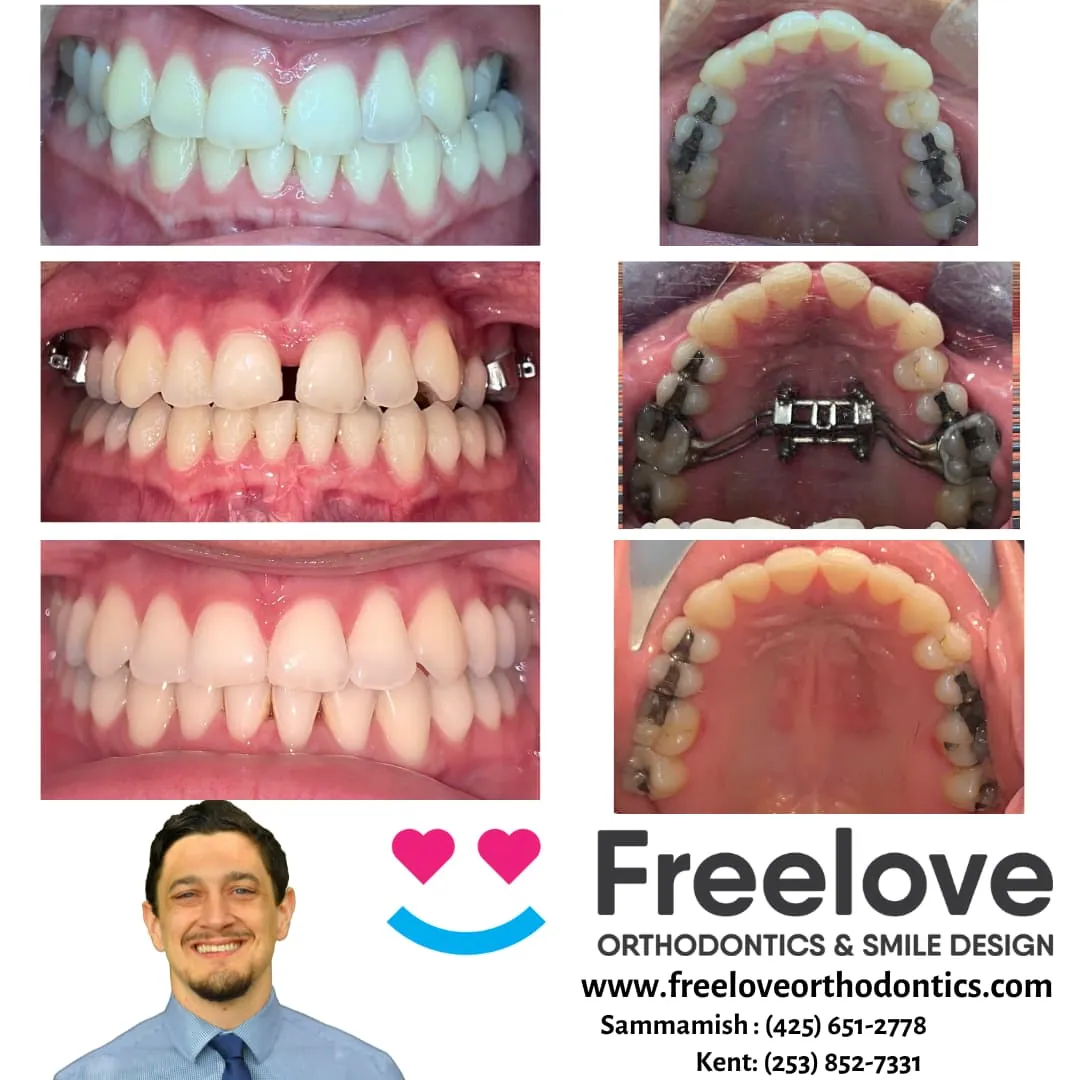
Results vary by patient.


Palatal Expander FAQ
How much does a palatal expander cost at Freelove Orthodontics & Smile Design?
Expansion is priced as part of the overall treatment plan, and the exact fee is given at the free consultation. Payment options include In-House Financing (from $199/month), CareCredit’s 0% APR promotional financing, a 5% pay-in-full discount, and HSA or FSA funds.
Does a palatal expander hurt?
An expander is not usually painful. Most patients feel pressure for a few minutes after each turn. Soreness settles quickly, and over-the-counter pain relief helps in the first days if needed.
What age is best for a palatal expander?
Traditional expansion works best while the upper jaw is still growing, often before age 10, which is why an early evaluation matters. In older teens and adults whose suture has become more resistant to expansion, MARPE is used instead of a conventional expander.
What is MARPE and is it done in-office?
MARPE stands for miniscrew-assisted rapid palatal expansion. It uses small temporary screws to anchor the expander to the bone, which lets it widen a jaw whose suture has matured and is more resistant to traditional expansion, the situation in most teens and adults. Dr. Freelove places the MARPE miniscrews in-office at Freelove Orthodontics, anesthesia included, so there is no separate oral-surgeon visit for the screws. The expander itself is fabricated at a dental lab from a precise digital scan and CBCT.
Why does Freelove Orthodontics & Smile Design custom-fabricate every expander?
An expander is used when the upper jaw is too narrow, which can cause a crossbite, crowding, or a blocked-out tooth. Widening the jaw at the right time corrects the width problem and creates room, and it is most stable when done while the jaw is still developing.
Other Conditions a Palatal Expander Treats
Does Your Child Need an Expander?
A free consultation, with 3D imaging when indicated, measures suture maturity, airway volume, and jaw width. Dr. Freelove will tell families whether expansion is truly needed and, if so, which type fits the diagnosis, no guessing and no pressure.