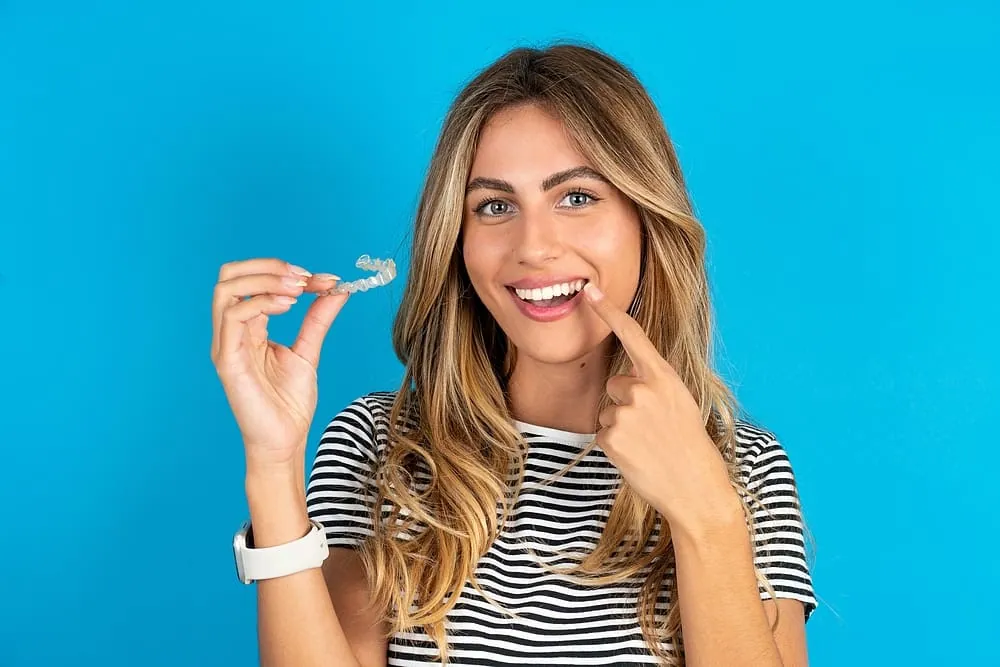
How does Invisalign work? Invisalign uses a sequence of clear, custom-made trays. Each tray is built to a position your teeth have not reached yet, so seating it applies light, continuous force to specific teeth. You typically switch to a new tray about every 7 days, wearing each one 20 to 22 hours a day, with small tooth-colored attachments added where extra grip is needed for more complex moves.
At Freelove Orthodontics, every Invisalign case starts with digital scans rather than messy molds, so Dr. Cameron Freelove can map out exactly how your teeth need to move before your first tray is ever made.
From there, the plan is personal. Two patients can start with similar-looking smiles and still need very different tray sequences, because the direction, order, and number of steps depend on what each specific bite actually needs.

What Invisalign Is
Invisalign is a clear aligner system. Instead of fixed brackets and wires, treatment is delivered through a series of custom, removable, transparent trays. You wear each tray for a set period, then move on to the next one in the sequence.
Every tray comes from a digital plan that maps your treatment in advance. The first tray in your series is built close to where your teeth are right now. The last tray is built to your planned finished result. Everything in between is a step along that path.
The trays are nearly invisible, which lets you get through your day, and your photos, without a mouth full of metal. Because they are removable, eating and cleaning stay simple, which is one of the most common reasons patients choose Invisalign in the first place.
Understanding the Technology Behind Your Plan
The Invisalign system uses digital tools to map out every tooth movement before treatment begins. This imaging technology is what allows Freelove Orthodontics to build a treatment plan that is specific to your bite rather than a one-size-fits-all approach.
According to Dr. Andre C. Jham, a board-certified orthodontist at Star Smiles Orthodontics and Pediatric Dentistry in Bloomingdale and Naperville, IL, this kind of smart technology helps make sure your teeth shift just how they should. Using Align Technology, the team no longer has to guess. You get to see a preview of your smile transformation before you even start, which helps you understand each step of the process before committing to it.
How Do the Aligners Actually Move Your Teeth?
It can be hard to picture how plastic moves teeth. Each Invisalign tray uses gentle, sustained force. Every tray is made to fit snugly, and each one in the series is shaped slightly differently than the last. That small shape difference is what guides your teeth a little further toward their new position.
This movement happens in small, safe steps. Most patients change to a new tray about every 7 days. With each change, your teeth move a bit more, and that steady, incremental process is what adds up to a full smile transformation over the course of treatment.
The Role of Attachments
Attachments are small, tooth-colored shapes bonded to certain teeth. Think of them as little handles that help the aligner grip the tooth more precisely. That extra grip lets your doctor plan more complex movements, like tricky rotations or specific bite corrections, that a smooth tray alone could not reliably achieve.
Attachments are tooth-colored and blend in with your smile, so they keep the aesthetic benefits of Invisalign intact even while doing more demanding mechanical work.
Comfort and Convenience
The smooth trays sit gently against your gums, which generally means fewer mouth sores than what patients experience with metal brackets and wires. Because the trays are removable, your daily routine changes very little, and you will not need emergency visits for a broken wire or a popped bracket.
Wearing Your Aligners: The Key to Success
Compliance is the single biggest factor in how well your treatment works. Your trays need to be in your mouth for 20 to 22 hours a day, removed only to eat, to drink anything other than water, or to brush and floss.
If you do not wear your trays as instructed, your teeth stop tracking the plan, which can extend your treatment duration. Sticking to the schedule your doctor sets is what keeps your case moving toward its finish line on time.
Lifestyle Benefits
Invisalign is built to fit around your life rather than the other way around.
- Eat what you want: trays come out to eat, so nothing is off-limits, including popcorn, nuts, and apples that would be risky with metal braces.
- Sports and hobbies: aligners can be removed for contact sports or for playing a wind instrument.
- Special events: for a wedding or a big speech, trays can come out for an hour or so.
- No visible metal: nothing shows up in your photos.
When Invisalign May Not Be the Right Fit
Invisalign works well for a wide range of cases, but it is not automatically the right tool for every bite. Some movements, particularly complex rotations or more involved bite corrections, need the extra grip that attachments provide, and even then, some cases are still better served by traditional braces. Part of your consultation is an honest look at whether your specific case is a strong match for aligners or whether another approach will get you to your goal more reliably.
Progress Checks and Monitoring
You are not on your own once treatment starts. You will come back to Freelove Orthodontics for short check-ins, usually every 10-20 weeks, so the team can:
- Check how your teeth are tracking against the plan.
- Take additional scans if needed.
- Hand you your next set of aligners.
If your teeth are not moving exactly as planned, that is not a crisis. Because the plan is digital, your doctor can adjust the map and order a refinement (a few extra trays) to bring your case back on target.
Caring for Your Trays
Keeping your aligners clean is a simple part of the routine.
- Take your trays out before you eat. Food can get trapped against them and cause damage.
- Brush your teeth before putting trays back in, so sugar and bacteria are not trapped against your enamel.
- Clean your trays gently with cool water. Hot water can warp the plastic.
- Store trays in their case whenever they are out of your mouth, so they do not get lost.
Results and Retention
Once you finish your last tray, the doctor does a final check, sometimes with new scans, to confirm every tooth has reached its planned position. From there, you move into the retention phase. Teeth can drift back after any orthodontic movement, so a retainer is needed to protect your results. Most patients wear a retainer long term, moving from full-time wear early on to nighttime wear over time.
How Invisalign Addresses Common Bite Issues
| Alignment Issue | How Invisalign Helps |
|---|---|
| Crowding | Gradually creates room and repositions bunched-up teeth into better alignment |
| Spacing | Closes gaps between teeth through a planned sequence of trays |
| Overbite | Guides top teeth back into a more balanced position over the upper and lower arch |
| Underbite | Repositions the lower teeth relative to the upper arch |
| Crossbite | Corrects teeth that sit incorrectly inside or outside the opposing arch |
| General bite issues | Managed with attachments and a specific tray sequence for more complex movement |
The Freelove Orthodontics Invisalign Process
Step 1: Consultation and Diagnosis
Your treatment journey starts with a consultation at Freelove Orthodontics in Kent or Sammamish. The team performs a detailed exam of your teeth and bite to identify issues like crowding, gaps, or other alignment concerns, then discusses your goals to see if Invisalign is the best fit for your smile.
Step 2: Digital Scans and Planning
Digital scans replace the messy, uncomfortable impressions of the past. A special wand captures thousands of images in seconds to build a 3D map of your mouth. This map supports your diagnosis and gives you and your doctor a clear starting point, along with an explanation of what to expect during your treatment.
Step 3: Your Custom Treatment Plan
After your scan, your doctor uses planning software to build your treatment plan, mapping each small tooth movement from your starting point to your final bite alignment. You will also get a treatment timeline. Duration usually runs 12 to 18 months, though your exact process depends on your specific needs.
Step 4: Getting Your Aligners
Once you and your doctor agree on the plan, your trays are ordered. When they are ready, you come back to the office to receive your first few sets, learn how to put them in and take them out, have the fit checked, and get your specific care instructions.
What a Consultation Can (and Can’t) Tell You Remotely
An article like this one can explain the general mechanics of Invisalign, but it cannot tell you whether aligners are right for your specific bite. That only comes from an in-person exam and a digital scan at Freelove Orthodontics, where your doctor can see exactly what your teeth and jaw need. If you have questions before booking, the team is glad to talk them through. You can reach the office directly through the Contact Us page.
Who Can Use Invisalign?
Invisalign works for both adults and teens, and it can address mild, moderate, and some more complex alignment issues, including crowding, spacing, overbites, underbites, crossbites, and general bite problems. For very complex cases, traditional braces might still be the better option, and the team will let you know honestly at your consultation which approach fits your case best.
Why Choose Freelove Orthodontics?
Freelove Orthodontics stands out on care and expertise with the Invisalign system. Patients can expect a friendly, stress-free team, high-tech scanning and planning tools, personal attention from Dr. Freelove, who listens to your goals, and a custom plan built around your life, not a generic template.
Frequently Asked Questions
How often do you change Invisalign trays?
Most patients switch to a new set of Invisalign trays about every 7 days. Dr. Freelove gives you a custom schedule, and switching on time is key to keeping your treatment on track.
What is the failure rate of Invisalign?
Invisalign has a very high success rate of about 96%. Most “failures” happen when a patient does not wear the trays for the recommended 20 to 22 hours a day. Following the compliance rules is what keeps your smile transformation on track for success.
What age is best for Invisalign?
There is no single “best” age, but most people start once all their adult teeth are in, usually around age 12. Invisalign works well for teens and adults of all ages at Freelove Orthodontics, as long as your teeth and gums are healthy enough for treatment.
Will my Invisalign attachments be noticeable when I smile?
Attachments are tooth-colored and designed to blend in with your natural teeth. They keep the aesthetic benefits of Invisalign intact while giving your doctor the extra grip needed for more precise movements.
Can I take my aligners out for special occasions?
Yes. For a wedding, a big speech, or another special event, you can remove your trays for an hour or so. Just make sure to get back to your full 20 to 22 hours of daily wear as soon as the occasion is over, so your treatment stays on schedule.
Sources. Clinical guidance from Freelove Orthodontics, and commentary from Dr. Andre Correia Jham, orthodontist at Star Smiles Orthodontics and Pediatric Dentistry in Bloomingdale and Naperville, IL, on digital treatment-planning technology.
Related Reading
- Clear Braces vs Metal Braces in Kent and Sammamish, WA
- How Long Does Invisalign Take in Kent and Sammamish, WA
- TMJ Treatment in Kent and Sammamish, WA
- How to Get Braces Glue Off Teeth in Kent and Sammamish, WA
- How to Floss with Braces in Kent and Sammamish, WA
Start Your Journey with Confidence
Ready to see if clear aligners are right for your smile? Schedule your consultation with Freelove Orthodontics in Kent or Sammamish, WA, and the team will build a plan around your specific teeth and goals.
Free consultation for new patients.